

Quick Facts: The “Split Bill” Phenomenon
| Charge Type | What It Covers |
|---|---|
| Professional Fee (Pro-Fee) | The doctor’s time, expertise, and direct services (Usually billed on a HCFA-1500 form). |
| Facility Fee | The overhead cost of the building, equipment, nurses, and electricity (Billed on a UB-04 form). |
| Provider-Based Billing | When a hospital buys a private clinic and legally starts charging hospital-level facility fees for regular office visits. |
The Shock of the “Double Bill”
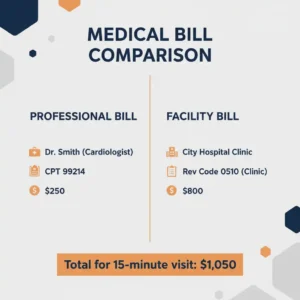
One of the most confusing aspects of the U.S. healthcare system is receiving multiple bills for a single visit. You go to a clinic, see one doctor for 15 minutes, and weeks later, two separate invoices arrive in the mail. This is not necessarily a mistake; it is the practice of splitting charges into a Professional Fee and a Facility Fee. However, while legal, this practice is frequently abused, resulting in massive, unexpected out-of-pocket costs for patients.
Typical Clinical Scenario: The $1,000 Consultation
Presentation: A patient visits a cardiologist for a routine check-up. The clinic is located in a standard office building, but the building is owned by the local hospital system.
The Bills: The patient receives a bill from “John Doe Cardiology” for $250 (Professional Fee). A week later, a second bill arrives from “City Hospital System” for $850 (Facility Fee).
The Trap: Because the clinic is technically a hospital outpatient department (HOPD), they are allowed to charge “Provider-Based Billing.” The patient pays $1,100 for a visit that would have cost $250 at an independent doctor’s office.
How to Decode the Two Bills
To audit these charges, you must request an Itemized Bill for both invoices. (See also: How to Request an Itemized Bill). Once you have them, look for the following codes to ensure you aren’t being double-charged:
1. Identifying the Professional Fee (CPT Codes)
The physician’s bill should use 5-digit CPT (Current Procedural Terminology) codes. These codes describe the intellectual work performed. For example, CPT 99213 represents a mid-level office visit. Check these codes carefully to ensure the doctor isn’t engaging in Upcoding. (See also: How to Spot Upcoding).
2. Identifying the Facility Fee (Revenue Codes)
The hospital’s bill will use 3- or 4-digit Revenue Codes (e.g., Rev Code 0510 for Clinic, Rev Code 0450 for Emergency Room). Facility fees are designed to cover the high overhead of emergency rooms and surgical suites. However, major hospital networks increasingly apply these fees to routine outpatient clinics simply because they own the building.
Actionable Steps: Fighting Unfair Facility Fees
While facility fees are notoriously hard to fight because they are legally permissible in many states, you still have leverage:
- Check for Lack of Disclosure: In several states (e.g., Washington, Connecticut), hospitals are required by law to explicitly inform you before your appointment that you will be subject to a facility fee. If they did not provide this written notice, you can dispute the charge.
- Ensure In-Network Status: Sometimes the hospital facility is in-network, but the specific doctor (professional fee) is out-of-network, or vice versa. If this happens at an in-network facility, you may be protected by the No Surprises Act.
- Negotiate the Facility Fee: Facility fees have the highest markup of any medical charge. They are often the easiest charges to negotiate down if you are uninsured or paying out-of-pocket. Offer to settle the professional fee in full in exchange for dropping or drastically reducing the facility fee. (See also: How to Negotiate Hospital Bills).
If your insurance denied the facility fee portion, leaving you with the balance, use our AI Appeal Letter Generator to request a review of the claim.
Frequently Asked Questions
Are facility fees covered by health insurance?
Usually, yes, but they are often subject to your deductible. This means if you haven’t met your annual deductible, you will be responsible for paying the entire inflated facility fee out-of-pocket, which is why they cause so much financial shock.
How can I avoid paying facility fees in the future?
Before scheduling an appointment, explicitly ask the scheduling desk: “Is this office an independent clinic, or is it considered a hospital outpatient department? Will I be charged a separate facility fee?” If the answer is yes, look for an independent, privately-owned practice for routine care.