
Quick Facts: Medical Bill Negotiation
| Strategy | Potential Impact |
|---|---|
| Itemized Bill Request | Identifies errors in 80% of hospital bills; immediately lowers cost. |
| Fair Market Price Lookup | Provides a baseline for what insurance usually pays vs. the “sticker price.” |
| Prompt Pay Discount | Often results in an immediate 10%–30% reduction for one-time payment. |
| Lump Sum Settlement | Can reduce total debt by 50% or more for older bills. |
Why You Should Never Pay the First Bill
In the United States healthcare system, the initial bill you receive is often a “chargemaster” price—an intentionally inflated rate that functions as a starting point for negotiations with insurance companies. If you are uninsured or have a high-deductible plan, you are being asked to pay a price that no insurance company actually pays. Negotiating is not only possible; it is a standard administrative practice. Success lies in shifting from a defensive posture to a data-driven inquiry.
The “Golden Rule” of Negotiation: The Itemized Bill
The most effective “hack” for lowering a medical bill is requesting an Itemized Statement. Hospitals frequently send “summary bills” that group charges into vague categories like “Pharmacy” or “Lab Services.”
When you demand an itemized bill, the hospital must list every individual CPT code and service provided. This simple request often leads to the immediate removal of “accidental” duplicate charges or services that were never rendered.
Advanced Tactic: Leveraging Fair Market Value
Once you have the itemized CPT codes, use objective data to challenge the pricing. Websites like Healthcare Bluebook or Fair Health Consumer provide the “Fair Market Price” for procedures in your specific zip code based on what insurance companies actually pay.
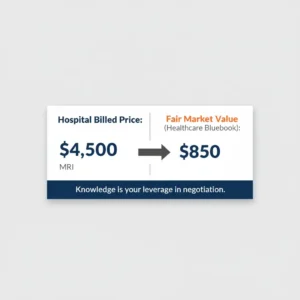
The Script: “I see you are charging $3,000 for CPT code 70450 (CT Scan). According to Fair Health data, the average negotiated rate in this area is $650. I am willing to pay the fair market rate today to settle this account.”
Typical Clinical/Financial Scenario: The “Self-Pay” Victory
Presentation: A patient receives a $5,000 bill for an outpatient procedure after their insurance denied the claim as “out-of-network.”
Action: The patient requests an itemized bill and discovers a $400 charge for a “surgical kit” that was never used. They then research the Medicare reimbursement rate for the procedure, which is $1,200.
Resolution: The patient offers a lump-sum payment of $1,500 (Medicare rate + 25%) to close the file. The hospital accepts the offer rather than sending the debt to collections.
Negotiation Phrases That Work
- “Can you offer me the Medicare reimbursement rate?” (The lowest baseline price hospitals accept).
- “Do you have a prompt-pay discount if I pay the balance in full today?”
- “I am unable to pay this amount. Do I qualify for Charity Care under your Financial Assistance Policy?” (See also: Charity Care Eligibility Guide).
- “I request that you hold this account from collections while we negotiate the final price.”
Frequently Asked Questions
Will negotiating my medical bill hurt my credit score?
No, as long as you are in active communication with the hospital billing department. Debt only affects your credit score if it is sold to a collection agency and remains unpaid for more than 180–365 days (depending on current US credit reporting laws).
What if the hospital refuses to negotiate?
If the billing department is uncooperative, ask to speak with a Patient Advocate or a Financial Counselor. If the bill involves a surprise out-of-network charge, mention that you are aware of your rights under the No Surprises Act. This usually escalates the case to someone with the authority to offer a discount.