Clinical Definition
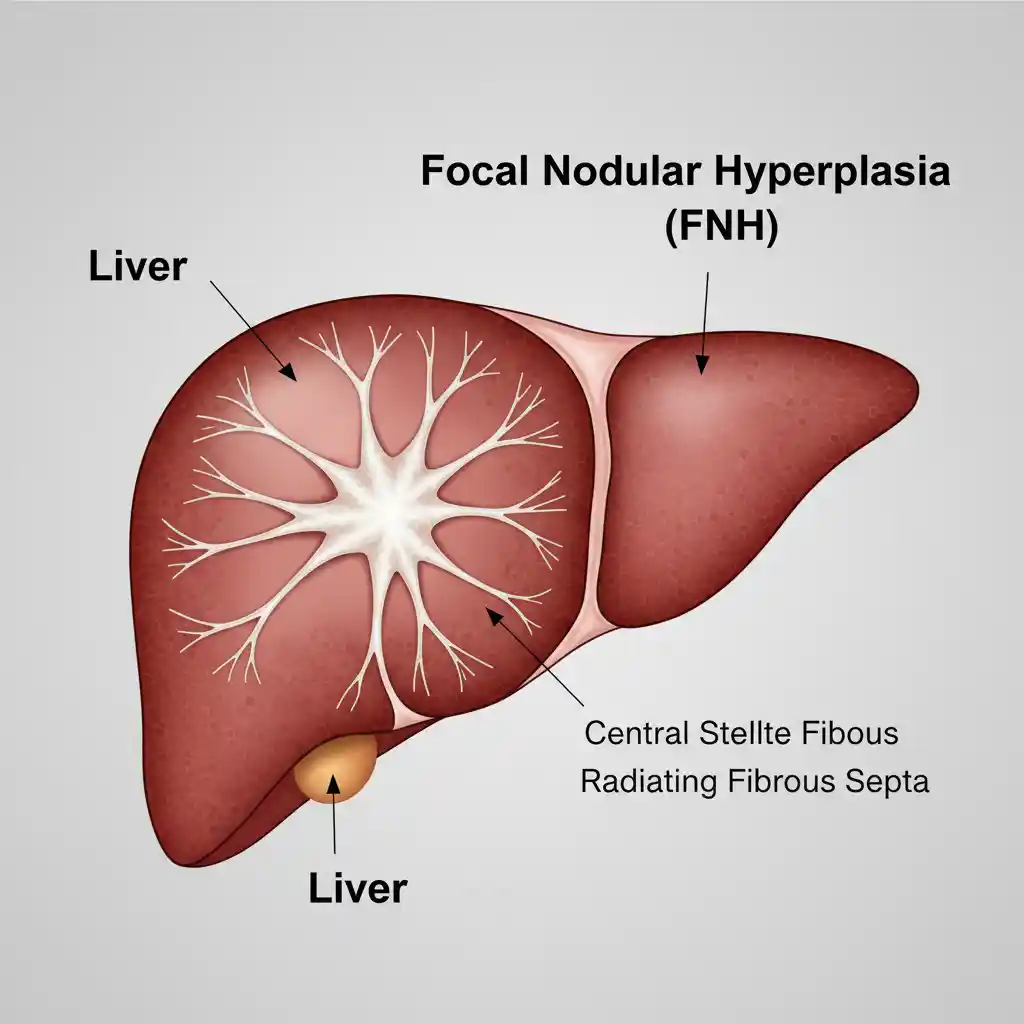
Code K76.89 is an ICD-10-CM diagnosis code used for billing and reimbursement purposes. It represents a residual category for various specified, non-neoplastic diseases of the liver that do not have a more specific code. The primary clinical information associated with this code points to conditions such as Focal Nodular Hyperplasia, which is a benign, regenerating hepatocellular hyperplasia often secondary to focal vascular abnormalities. It also encompasses simple, idiopathic cysts of the liver and conditions like hepatoptosis.
Clinical Coding & Classification
Status: K76.89 is a billable and specific ICD-10-CM code.
Effective Date: The 2026 edition of ICD-10-CM K76.89 became effective on October 1, 2025. Claims with a date of service on or after October 1, 2015, require the use of ICD-10-CM codes.
| Code Range | Description |
|---|---|
| K00-K95 | Diseases of the digestive system |
| K70-K77 | Diseases of liver |
| K76.- | Other diseases of liver |
Applicable To & Synonyms
- Cyst (simple) of liver
- Focal nodular hyperplasia of liver
- Hepatoptosis
- Hydrohepatosis
- Liver lesion / Liver nodule
Pathophysiology (Mechanism)
The pathophysiology for conditions under K76.89 varies. For Focal Nodular Hyperplasia (FNH), the mechanism is believed to involve a localized hyperplastic response of hepatocytes to a pre-existing vascular anomaly, such as an aberrant artery. This leads to a well-demarcated but benign nodule with a characteristic central fibrous scar. For a simple liver cyst, the mechanism involves the progressive dilation of aberrant bile ducts (von Meyenburg complexes), leading to the accumulation of serous fluid within an epithelial-lined cavity.
Standard Management Protocols
Management for conditions coded under K76.89 is highly dependent on the specific diagnosis and clinical presentation. Standard management often involves…
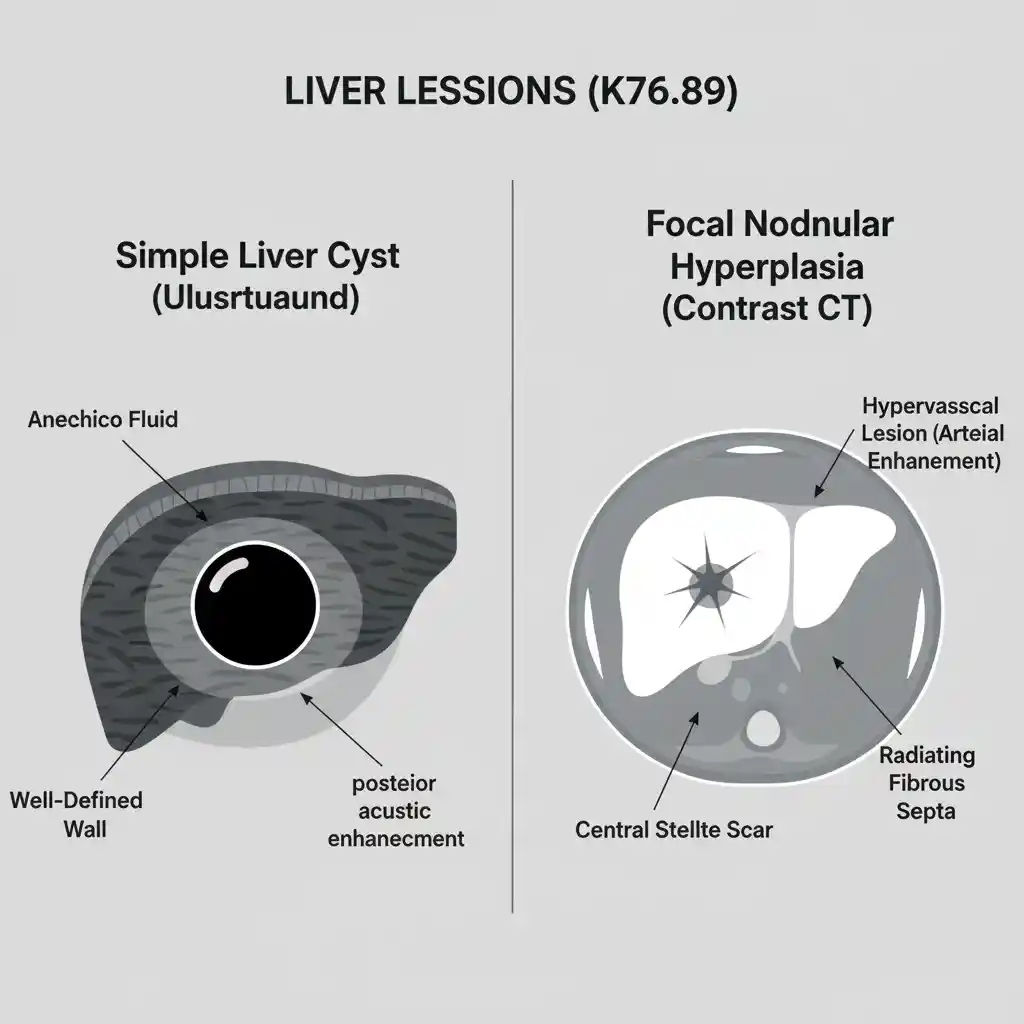
- Diagnostic Procedures: Clinicians typically utilize imaging studies to differentiate these conditions.
- Ultrasound (CPT 76700, 76705): Often the initial imaging modality for detecting liver cysts or nodules.
- Contrast-enhanced CT or MRI (CPT 74177, 74183): Crucial for characterizing lesions, particularly for differentiating FNH from other hepatic tumors based on its typical arterial enhancement and central scar.
- Intervention: Most conditions under K76.89, such as asymptomatic simple cysts and FNH, are benign and do not require intervention. Management is typically conservative with periodic monitoring. Surgical intervention may be considered only if the lesion is very large and causing significant symptoms (e.g., pain, compression of adjacent organs).
Healthcare Resource Utilization
MS-DRG Assignment
For inpatient hospital reimbursement, ICD-10-CM code K76.89 is grouped within the following Medicare Severity-Diagnosis Related Groups (MS-DRG v43.0):
- MS-DRG 441: Disorders of liver except malignancy, cirrhosis or alcoholic hepatitis with Major Complication or Comorbidity (MCC)
- MS-DRG 442: Disorders of liver except malignancy, cirrhosis or alcoholic hepatitis with Complication or Comorbidity (CC)
- MS-DRG 443: Disorders of liver except malignancy, cirrhosis or alcoholic hepatitis without CC/MCC
This grouping highlights that the reimbursement level is determined not just by the diagnosis K76.89 itself, but by the presence of other complicating conditions.
Historical & Cross-Reference Data
- ICD-9-CM Conversion: A tool can be provided to convert K76.89 to its ICD-9-CM equivalents for historical data analysis.
- Code History: K76.89 is a new code effective from October 1, 2015, with no subsequent changes to its status.